
✒ French Press
A poem

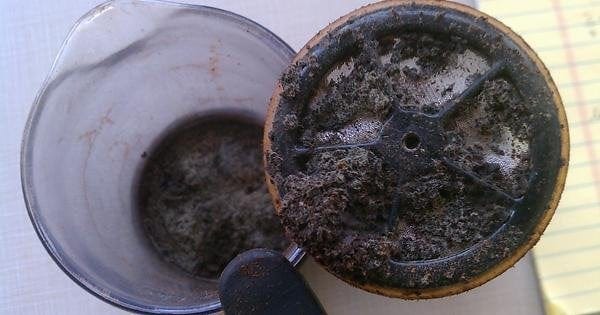
I’ve been writing a collection of poems.
It’s called Stuff: Banal Relics of our Industrial Present.
Don’t get too excited…
I know you. You like high-minded, pretentious musings about everyday products (microwaves, folding chairs, Keurigs etc.). You are, after-all, a most generous reader with a large vocabulary and a refined linguistic pallet. For this collection, my hope is to have a bit of that savory thinky-thinky stuff you eat at a fine dinner, but mostly, I want this collection to taste like a gourmet “pocket” sandwich, which is to say, I want my poems to sound like what I’d imagine Larry David’s poetry would sound like, or more specifically, what Larry David’s poetry would sound like if he held an M.A. in a useless field.
So far it’s a lot of silly rambling about the tedious ins-and-outs of our shared existence centering on… you guessed it… stuff.
In a world that is unofficially fueled by “annual replacement theory” (the phrase I just made up to describe our national economic model in which every object in every person’s home must be broken and replaced within a single year lest the economy plummet into another of its many, many, many needy/depressive episodes, re-re-binge-watch BoJack Horseman, pour its whisky straight from flask to Super-Size-Me’d McDonald’s coke, and microwave the Pizza Rolls in daily batches to save on steps so it can diligently spend the time texting that guy it really has no business reconnecting with) we are all bound to have way, way more stuff than we need, but also way, way too few things to complete the tasks we must complete in order to survive.
It’s a bizarre paradox. Somehow, I can own more objects than God. More things than pieces of art my five-year-old can make in a week; yet when it comes time to fix something I somehow don’t have a single god-damn flat-head screwdriver and (for the millionth time) I’m reduced to using a dime pinched between my fingers. And I don’t think I’m alone in this… name your economic dystopia and we’ve caught ‘em all baby!
Scarcity? Sure thing boss! Try buying a house! Or, better yet check your local food bank. It never has enough to go around and somebody who is working four jobs has kids that are going hungry today.
Glut? Why not… we’ll take it! Google the latest Uber-Cyber-Tweensday Furniture of the Month Club sale (likely sponsored by Disney). Or better yet, ask the statisticians who will tell you that there are ten thousand plastic doodads punched out on industrial presses every second and they are all currently on their way to your house in four Amazon trucks which hide the giant cardboard boxes which hide the plastic sleeves that drape (like tacky negligee) off those other colorful cardboard boxes which contain plastic trays holding sheets of thin white styrofoam that cushion the stuff you will receive and break within twelve months lest the economy etc. etc.
Anyway. Too much stuff. We all live with it. Our decadent pile unites us.
Maybe it unites us in a commiseratory “Keep Calm and Carry On” kind of way, or maybe it unites us the way that dirty family secrets tie people together around say… the hidden sexual proclivities of an uncle or a Klan affiliation or a generations long battle with booze.
Maybe it’s a terrible yoke on our collective necks, but beneath that yoke, we’re all working hard together, heaving in tandem a sled which carries our cherished leader: The Economy.
And before you ask, he couldn’t possibly stand to walk… been so depressed you see. And he’s only on season 2 of BoJack.
French Press

For Karal Ann Marling

        I

Only the French could invent such elegance.
Only an American could expect it to survive
on the kitchen counter
of an American.

If it wasn’t really the French who made it
and we give it their name
to imbue a sense of class into an
ostensibly classless object

(like the humble fry) then
I’d bet a cup of coffee
that the true inventors were
almost certainly Dutch,

or Germans, or Swiss: some other people
with brains like meticulous clocks,
people for whom meals are eaten
upon an even time table,

a people not rushing from coffee to gig,
gig to gig, gig to kids, kids to bed.
But try calling it a “German press” and
that brings to mind some formation

used to great and terrible effect by the Luftwaffe.
The “Dutch press” is not a kitchen implement at all
but rather a kind of suplex used by wrestlers
and prostitutes to force a climax.

The “Swiss press” is better. Best perhaps because
of that soft “s” on front and back. Ergonomically named.
Like whipping a switch through tall grass. Swiss press
But it’s not a Swiss press, and we’ll leave it at that.

       II

Sometimes I absorb a phrase the way coffee
grounds soak up water. An errant line
about a wrist watch that is actually a mausoleum
perhaps, or “there was what she said,

and what she meant and something
between the two that was neither”
or something else
seeps in with no memory of Henry or William

or whoever. It's the words only
but the words intact, there to work their wonders
imprecisely on the stuff inside my skull.
And just like the coffee grounds

that stuff is soaked through and
produces something else in kind.
I wonder if the formless waters
at the start of it all,

the ones contained like a sparrow’s egg
within the gentle palm of darkness,
felt (and now feel) the same way
about the rambling voice of God;

I wonder if they remember what was said
on that second day, still play the words on repeat
through their wet microbiome with no notion
of the one who spoke them.

       III

Upon reviewing E.T. somebody said
"the homes in this movie are authentically
American, they bear the marks of hard use”
and I thought it was Roger Ebert

who said it, because "in the beginning was
the word, and then there was Roger Ebert
to make use of it when critiquing light."
I Googled though and, wouldn't you know it,

I was wrong. And I wasn’t sure who said it,
the teller lost to time (or lost to me for a time
until I found them for dedicating this poem to.
Good artists plagiarize, great artists steal.

But nervous artists? We attribute / dedicate).
Even if I couldn’t remember who said it
damned if the idea hasn’t soaked in:
my home “bears the marks of hard use.”

The phrase bubbles to the surface the stuff
inside my skull every time a rag begins to tatter
or a Tupperware dons the gentle orange stains
of chili and taco meat or

our freezer starts to make that noise
(the one like a frozen hand scritch-scritch-
scratching its way to an open grave)
or my fourth french press falls fast,

slipping from wrinkled soapy hands,
or flying aside as someone catches my stumbling son,
or stumbles itself amidst a jungle of artwork a daughter
made for someone to see amidst the glitter on a tabletop.

That glass french press always fell and always exploded
like a beaker grenade, dead upon touching the floor.
Finally we bought a metal one-- a solution taken far too late--
and this metal press, too, “bears the marks of hard use.”

No merciful oblivion will put it to rest, of course,
but heated to 212 degrees Fahrenheit twice daily,
stirred with a scratchy metal spoon,
plunged with elbow grease

and verve and prayer because
my gummed up coffee grounds come from Aldi
and are not fit for the fine mesh filters
found for cheap-ish on Amazon.com.

       IIII

And despite it all, the symmetry
of the French press dazzles:
Four tablespoons. Four minutes.
Four cups of coffee.

Like ringing a bottle
or, better yet, nailing a between-the-legs
three-pointer with
middle aged dignity still intact.

Whoever may have made this thing originally
(the “Prime Mover” if you will)
is now of little consequence
it was likely a Laotian or Chilean or Pakistani

who made the one that sits on
my kitchen counter. And sometimes
when I take a slurp of that morning’s perfection
I wish I could hold their face

between my wet soapy palms
and gently shake it with my vigorous love
“Something so fine?” I would say,
“so delicate, so elegant, to live in my house of hard use?

Are you insane? You beautiful bastard!
‘Here’s looking at you!’”
I would say, because someone said that once
to someone precious, but I don’t remember who it was.