
✒ Minesweeper
A poem

I wrote a poem about Minesweeper.
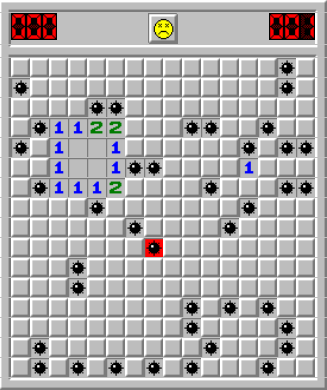
Like most digital artifacts, Minesweeper exists in a perpetual motion paradox. It is both more playable than ever and completely dead and gone. I blame improvements in screen resolution. Unless I can count the pixels in each square, I’m not interested in the game as a meditative exercise.
I’m joking.
My opinion on Minesweeper hasn’t changed a bit: I always hated it.
My brother loved it. He had a brain for logic. When he clicked a grey square and uncovered a number he would go “hmm” and then “ah-HA!” When I uncovered a number I saw a number that led to more numbers and all those numbers started to mush together into a numerical tapioca of despair.
I love words; therefore, I love knowing the two kinds of “number” nouns: the “how much” kind and the “how many” kind. The how much kind is called a mass noun. Love and tapioca are mass nouns. You can have more tapioca (a “larger mass”) but not in an easily divisible way. Mass nouns don’t use the plural s unless they are referencing multiple kinds (tapioca varieties on a desk or different loves). The how many nouns are called count nouns. Red Popsicles and border collies easily convert into discrete, numerical units (three border collies, half a Popsicle) and as such they get the plural s treatment, even when it’s more of the same: three red Popsicles, seven border collies (yous get the pictures).
As a kid, my brain only understood mass nouns. Stuff. More. Larger.
I could feel the little spiky mines beneath the grey squares like grains of sand in scrambled eggs, or tacks in bubble wrap, but I couldn’t figure out what the numbers were trying to tell me. I’d randomly click around, hoping to miss the mines, and inevitably this behavior would explode my little smiley man into a sad X-eyed totem of defeat.
Minesweeper made me feel dumb. Math made me feel dumber. Math homework made me feel angry, mainly with how dumb I was. I cheated as often as I could, or did the problems in my head. (How could I show work I couldn’t do?)
Then came Pre-Algebra, Algebra, and their big sister— Algebra II. Algebras. (Plural s because multiple kinds— not more of the same. See! Grammarians can be insufferable! Even on the internet!) Like John Green, I was never able to solve for X because on some fundamental level “I knew that ‘X’ was a letter, and the rest of them were numbers.”
Did you know that “algebra” is an Arabic word? It came to English from the Arabic world when Muslims between 700-900 created algebra during a golden age. An age in which ‘0’ was invented (what?) and algebra, Al Jazeera, and that sacred name for God were all linguistically linked. It was a kind of Renaissance in the heart of the Middle Ages but it substituted nude Greek gods/goddesses for intricate, geometric, Minesweeper mosaics. Less sexy perhaps, but a good deal better at helping you build a rounded arch.

Whelp. When I was fourteen or whatever, I would have liked to have met those Muslim geniuses— maybe they could have done my homework. By algebra proper (Algebra 1?) I’d given up on math equations altogether. I was done for. Cooked. Toasted lightly over a homework fire. Fattened up on stupid pills for the dumb-dumb circus. Dead.
Then my dad sat me down at the dining room table, and patiently explained equations via The Seesaw of Simplicity:
Dad: Imagine two guys on a seesaw. One of them is a big ol’ five, while the other is a shrimpy little one. Which guy’s side is going to be heavier?
Me: The fat guy’s side.
Dad: Now how many shrimpy guys do you need to balance the seesaw?
Me: Uhhh. More than one.
Dad: …
Me: Five.
Dad: *smiles in smug father*
And thus ‘X’ was solved with body humor.
Not only that, with a single story about fat kids, my dad cemented the basics of equations in my slippery brain. Suddenly, ‘X’ was not only solvable, but kinda obvious. Weird that I was solving, essentially, the exact same problem but with different words.
Why was one version so much easier?
There is a really mind-bending write-up about this cognitive process in Daniel T. Willingham’s indispensable Why Don’t Students Like School? First, consider the following riddle:
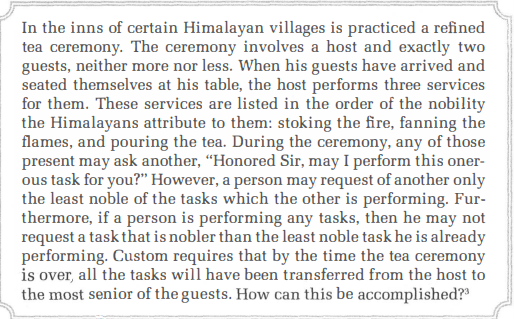
Like most people, if you managed to read all the way to the end, you’re probably thinking in groans and expletives right now. But given the following image…
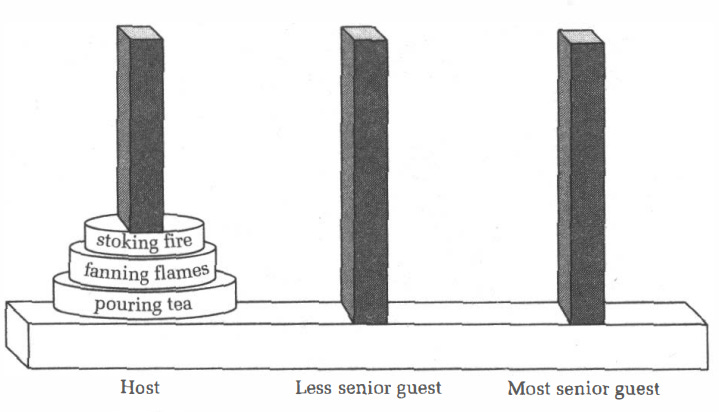
… the problem may not become easy but it will certainly get a lot more manageable.
What changed?
At least two things. The image helped you create a mental model (1) that drew on your background knowledge (2). You’ve probably never been to the Himalayas, but you probably do remember some form of this peg game from your nursery years. The concepts in the riddle get demystified, and you no longer need to hold a bunch of component parts in your head— freeing up brain space for solid work. Likewise, ‘X’ and ‘=’ are too abstract for some a’ us English brains, but everyone younger than Gen Z has been a kid on a dangerously imbalanced seesaw and wrought/reaped the consequences to crotch, spine, tailbone, etc. etc.
I’m thankful I had my dad to teach me equations. He showed me that my brain wasn’t dumb— just lacking the appropriate model for visualizing problems. And he did this nearly two decades before it was trendy for schools to talk about ‘learning differently’ and ‘neurodiversity.’ He did this without proper pedagogical training. Without neuroscience. Without science1 at all.
I’m not2 writing an education newsletter, so where am I going with this?
Maybe I’m trying to say that love is a mass noun— it’s very difficult to discern how much you have until you’ve got none and you realize you feel far, far lighter than you’d like— a parade float hovering above the mines and flags and numbers— all of it— coming in for a deflated return to warm ol’ earth.
Meaning is a mass noun too. Maybe that’s where poetry comes in: we’re trying to use words to help us sort grains of water.
Here’s the poem:
Minesweeper
A game for those rare humans
whose brain cells grow in grids
of grey matter.

A haunted game, a whisper from the past:
And lo’ there was a 90's desktop.
And I heard the voice of dial-up—

like a hamster screeching Daft Punk—
and the screen fizzed its single puckered eyelid
and upon the glass was grey, grey,

the terrible grid of grey,
bathing me in white light
teasing me with red flags–meaning nothing
because I meant nothing when I placed them.

Minesweeper:

One in a category of two—
solitary, save Solitaire.
... we mustn't forget Solitaire.

Minesweeper:

A cogent metaphor for how some conversations go.
Lost. Mis-stepping like klutzy ogres,
we two wait for the bomb to see us—
sweep us to a life in pieces.

Minesweeper:

A way to, fondly, recall
that there are some things
even nostalgia cannot resurrect.
As an aside, I sometimes worry that we “Science of [insert school subject]” people are trying too hard to turn learning into a count noun— something measurable and calculable, standardized and uniform, when all we really need to do to teach quote “dumb” students is bring to the table care, attention, and love. All we have to do is sit down with each student and work on giving them a model that “works.” A teacher who has the time and energy to see individual students can provide them with what they need. A teacher who doesn’t can’t. And no amount of data-driven, research-based, numerically countable education chips can change that. What I’m saying is that learning is a love and poverty equation. Love + Resources = Success. And no amount of AI-zapped stat drivel can substitute for those particular addends (look at me go!)
I also worry that schools are starting to assume it isn’t OK to dislike a particular field of learning: Algebra, Minesweeper—whatever, I still hate both. Just because a kid can read Shakespeare and write a solid poem doesn’t mean they enjoy doing those things. And it certainly doesn’t mean they should be made to do them at length.
Hey, I liked this one :) More than I like Minesweeper, anyway.
https://www.google.com/search?si=APYL9buSI-F50PSIMRDTTcU87fbXDuOev-yt6gd1Qso13ccKwdMQMc9hSIPaJQ7gFFsX8OY2retg&biw=1366&bih=647&dpr=1 new minesweeper